
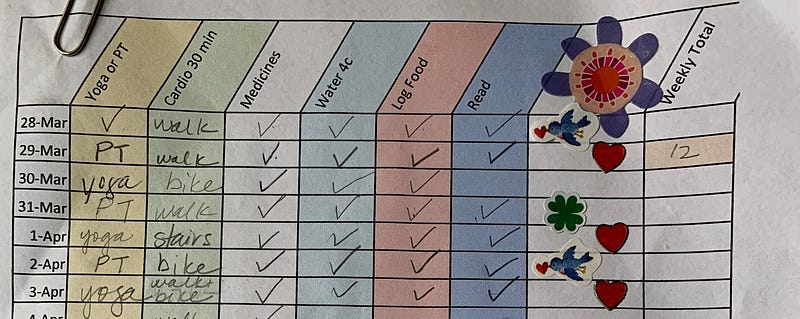
Friday, during a virtual happy hour with some colleagues, the conversation turned to COVID-19 coping techniques. My teammate, Marcy, shared that she was keeping a daily sticker chart for herself. This gave our group a good giggle, especially those who were being challenged to homeschool their children as they adhered to the shelter-in-place government mandate.
Marcy explaining that the daily sticker chart was actually her mother's idea. Her mother thought the visual would be an effective way to make sure Marcy was taking care of her wellbeing while she sheltered-in-place.
Marcy's list includes yoga, cardio, drinking water and reading. She let us know that since she started the chart, she'd gotten a sticker 6 out of 7 days and she was feeling pretty good.
Having data to show progress on wellbeing can motivate us. That's why health care professionals encourage us to track biometrics like our weight, blood pressure and take our temperature.
Much like Marcy's chart, we need to track activities that support our emotional wellbeing.
Tracking Your Wellbeing - Do It Yourself
Leaders,
The emotional dimension of employee wellbeing programs has been getting significant attention recently. This is due in part to the fact that mental illnesses have risen dramatically worldwide in the past 25 years. Roughly 1 billion of the 3.4 billion working adults globally suffer from anxiety, and one in four experience a mental disorder.
Be sure to take care of your emotional wellbeing during these extraordinary times and encourage your team members to do the same.
Here are some Do it Yourself wellbeing tips from my book "Disconnected - How to Use People Data To Deliver Realness, Meaning and Belonging at Work."
· Set goals. Consider the four components of your overall wellbeing - physical, emotional, social, and financial. Pick one, two or three wellbeing goals. Then set a target date for your goal to be achieved and reviewed with the respective professional, be it a someone from your employee assistance center, a health advisor or your financial planner. Schedule an appointment to review the progress.
· Get an accountability partner. Enlist the support of a friend to encourage you. - perhaps someone you believe does a good job with managing their wellbeing. Share your goals with them.
· Track your activities. It doesn't matter if it's a sticker chart, spreadsheet or another tracking mechanism. Remind yourself to stop and assess your progress on a regular cadence, be it daily or weekly. Consider using reminders on your calendar for critical tasks, such as taking medicine, exercise or calling and reconnecting with a friend.
Key Points: